A practical guide to New Territory’s established homes, recreation system, location, school-zone checks, HOA costs, gated sections, deed restrictions and the details buyers should verify before making an offer.
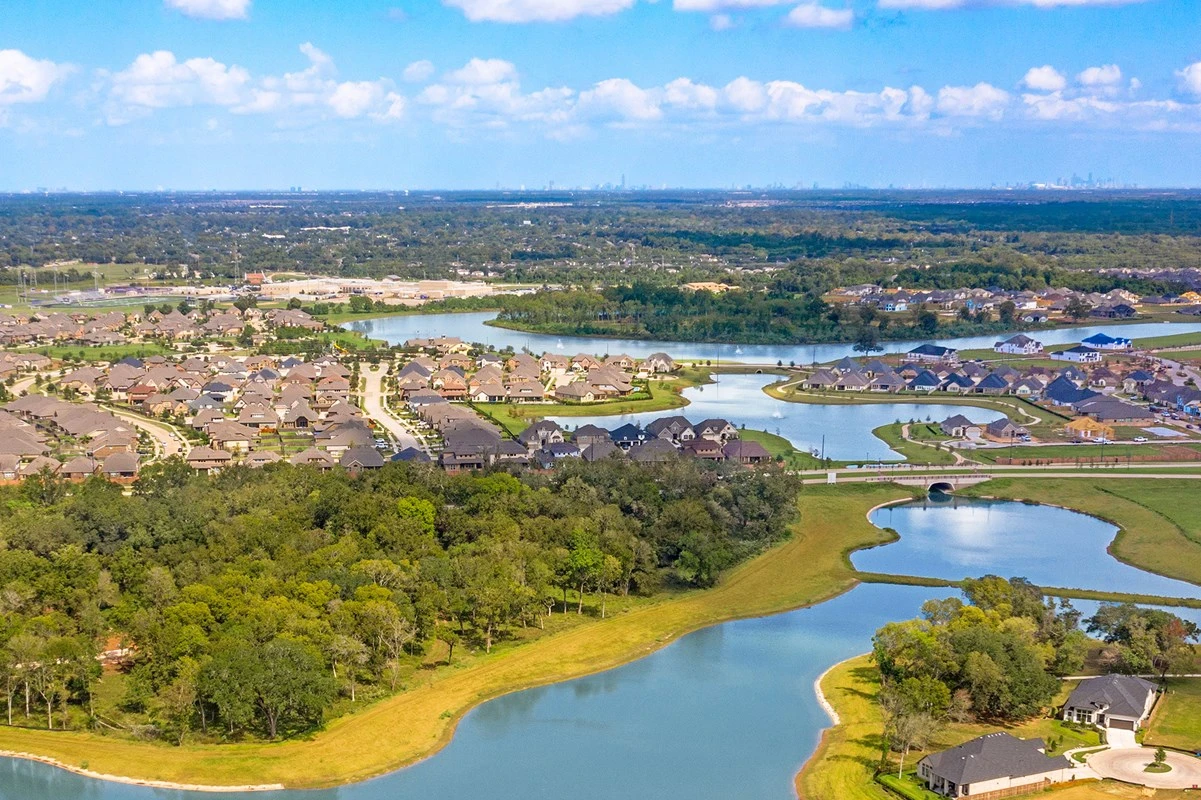
New Territory is a large, deed-restricted master-planned community in Sugar Land, Texas. It has mature trees, broad greenbelts, lakes, several recreation centers and 42 named neighborhood subdivisions. Most homes were built from the late 1980s through the early 2000s, so buyers usually get established surroundings rather than a brand-new subdivision.
That history is useful, but it also means New Territory is not one uniform housing product. A buyer needs to look at the exact address, the named section, the school assignment, the gate status, the association documents and any separate utility or drainage district line. This guide explains the big picture and then gives you a practical way to check the details that can change from one street to the next.
A clear starting point
New Territory is in Sugar Land, in Fort Bend County. The community association describes it as 3,200 acres with 4,603 single-family homes, 42 subdivisions and more than 17,000 residents. The association also says the community has more than 450 acres of parks, lakes and green space. Those numbers describe a large community, not a single street or a single set of rules.
Sonia Noman serves the Fort Bend and Greater Houston area, including Sugar Land, Missouri City, Richmond, Katy and Fulshear. No current transaction example is included here. For current listings or transaction-specific questions, the useful next step is to discuss the exact address with Sonia.
Where New Territory sits in Sugar Land
The practical locator for New Territory is south of U.S. Highway 59/I-69 and west of Highway 6 in Sugar Land. U.S. Highway 90A runs along the northern side of the wider area, and Grand Parkway/Highway 99 is part of the surrounding road network. The community is large enough that the road closest to a home matters. A showing should include the actual drive from the home to the school, grocery store, workplace route and recreation center you plan to use.
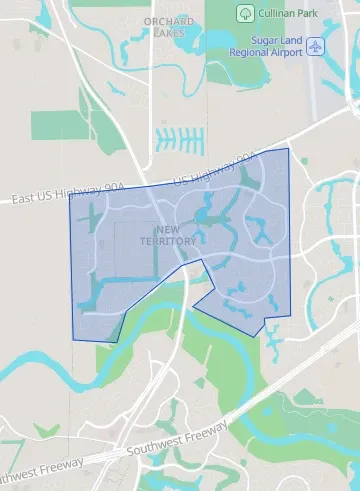
New Territory was initially in Sugar Land's extraterritorial jurisdiction and was annexed by the city on December 12, 2017, according to the community association's history page. That distinction matters when you ask which city service, utility responsibility or local rule applies to a particular address.
What makes New Territory feel established
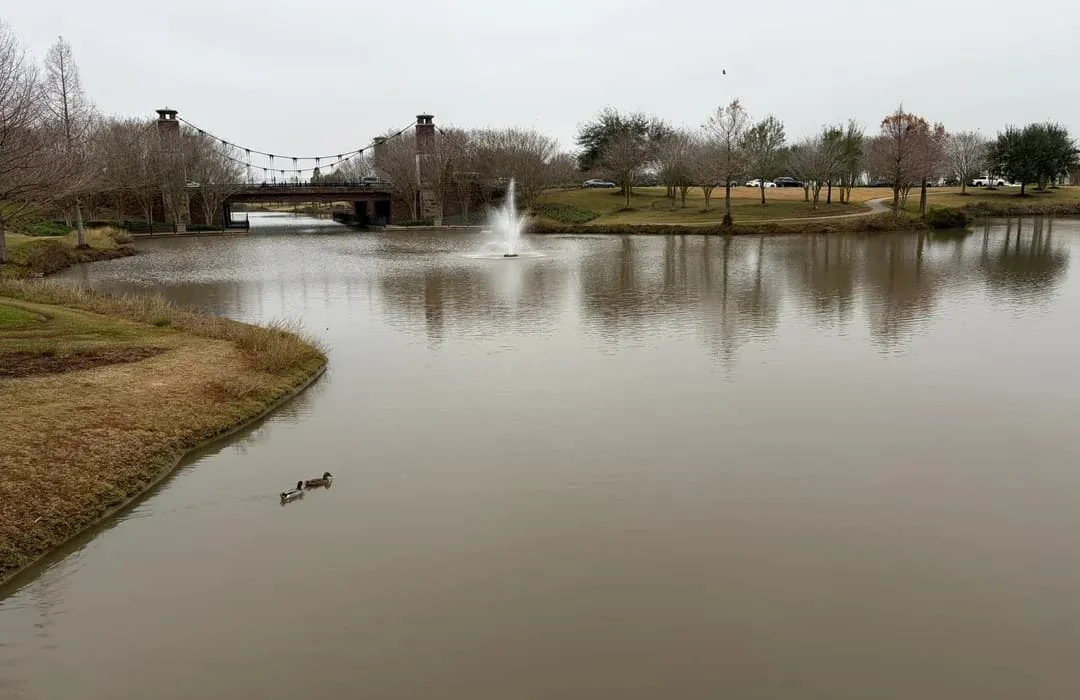
The first thing many buyers notice is the combination of planned open space and mature landscaping. The association describes 450 acres of parks, lakes and greenbelts, eight lakes, double-wide sidewalks for walking and biking, and a tree maintenance and reforestation program. The result is a community designed around shared outdoor space rather than a grid of houses with no common area.
The street pattern also matters. New Territory contains 42 named subdivisions, each with its own street layout, lot pattern and nearby park or lake relationship. Some sections sit closer to a recreation center. Some are on the east or west side of the community. Some are gated and some are not. A buyer should compare the actual route from the home to the amenities they will use, not just the community name.
The community's history adds to the feeling of maturity. The association says New Territory was built where old pecan groves and sugar cane fields once stood. The original developer was Markborough. The association lists original builders including Trendmaker, Emerald, Plantation, Ryland, Village, Coventry, Ashton Woods, Hammond, David Weekly, Newmark, Mastermark, Meridian, Fox & Jacobs and Perry Homes. A long list of builders can produce real differences in floor plans, lot sizes, windows, roofs, HVAC systems and later updates.
How New Territory developed
The development story has two dates that are easy to mix up. The Texas State Historical Association says the subdivision began in 1986. The New Territory Residential Community Association says home construction began in 1989 and continued through the early 2000s. Those statements can describe different stages: planning and subdivision work can begin before the first houses are finished. There is no need to force the two sources into one invented founding date.
The association was formed as a nonprofit community group in 1996. It describes a deed-restricted community with a professional compliance team, an on-site management team and a seven-member homeowner board. In 2017, New Territory joined the City of Sugar Land. That history explains why a buyer sees both a large master plan and a local association structure with rules, committees, maintenance standards and separate sections.
For a buyer, the practical lesson is simple: age is not one condition. An established home may have mature trees, a settled street and a useful location, but it may also have original systems that need careful inspection or improvements that were completed by a previous owner. The age range is a reason to inspect well, not a reason to assume every home has the same problem.
Homes and the 42 sections
The association's community snapshot counts 4,603 single-family homes across 42 subdivisions. That is the best supported housing description for the community as a whole. The wider real-estate market may use townhome-style language for nearby properties or for a particular property, so verify the property type, legal description and association documents for the exact address instead of relying on a neighborhood label.
New Territory is best understood as a collection of sections. The section name is useful because it points to the right subdivision documents, gate information, assessment schedule, school side and local park relationship. It is not enough to say only “New Territory” when you are comparing two homes.
Examples of named subdivisions
- Autumn Ridge
- Blakely Bend Sections 1 and 2
- Brandon's Pointe
- Cambridge Park
- Chapel Bend
- Cias Ridge
- Clayton's Bend
- Crescent Ridge
- Curran Place
- Easton Lakes
- Foster's Green
- Greystone Place Sections 1 and 2
- High Meadows
- Lake Pointe
- Lakewind Sections 1 and 2
- Laurel Crest
- Meadow Crest
- Meadowvale
- Morningside
- Pecan Park Estates
- Pecan Point
- Pointe Royale
- Preston Forest
- Remington Crest
- River Glen
- Robinson's Landing Sections 1 and 2
- Sander's Ridge
- Spencer's Glen
- Spinnaker Cove
- Sterling Chase
- Sterling Heights
- Stone Creek
- Stonehaven
- Summerhill
- Sunset Cove
- Tessa Lakes
- Thompson's Landing
- Walker's Station Sections 1 and 2
- Watermill Sections 1 and 2
- West Meadows
- Wilkin's Crossing
Confirm the exact subdivision name on the survey, deed and resale documents.
Compare the section, not just the house
Use this table as a starting point for a property-specific search. The table does not replace the title commitment, tax statement, resale certificate, school locator or association documents.
| Check | Gated sections | Other New Territory sections | How to verify |
|---|---|---|---|
| Base NTRCA assessment | 2026 example: $1,285 per year | 2026 example: $1,285 per year | Read the current assessment page and the resale documents. |
| Gated-community assessment | Pointe Royale: $700 in 2026; Pecan Park Estates: $230; Spinnaker Cove: $350; Sunset Cove: $600 | No separate gated assessment identified in the 2026 schedule. | Ask for the section budget, gate rules and current amount. |
| School assignment | Address-specific, even inside a gated section | Address-specific; the association describes an east/west split | Use the official FBISD locator and confirm with the district or registrar. |
| Community recreation | The Club, pools, parks, lakes, fields and programs are part of the wider community system. | The same community-wide system applies, subject to current rules and hours. | Check the association and recreation schedules before a showing. |
| Deed restrictions | Master documents plus any gated-section obligations | Master documents plus the relevant subdivision documents | Order the resale certificate and modification history early. |
| MUD or LID taxes | Verify the exact address | Verify the exact address | Read the tax statement, title paperwork and Fort Bend County records. |
“MUD” means Municipal Utility District, a special district that can provide water, sewer or drainage infrastructure and appear as a separate tax line. “LID” means Local Improvement District, another special district used to fund improvements. These are not the same thing as the HOA assessment, and the exact obligations can change by address.
The New Territory recreation system
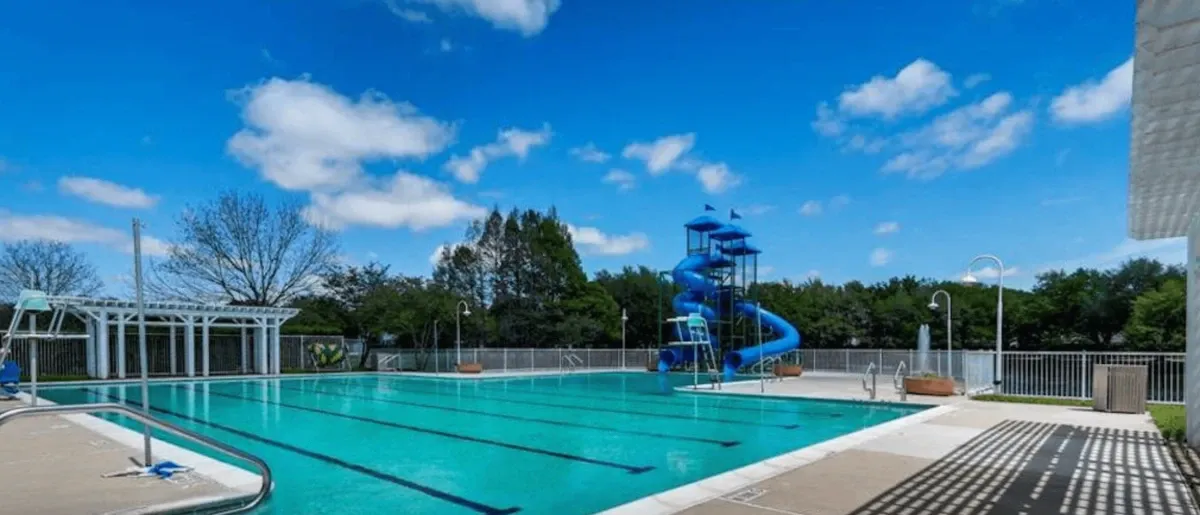
Recreation is one of the clearest reasons people compare New Territory with other Sugar Land communities. The association describes a community-wide system rather than one small clubhouse. The main facility is The Club at 1200 Walker School Road. It is an 18,000-square-foot recreation building with a gymnasium, fitness room, locker rooms, meeting rooms, a pool, a playground, pickleball, tennis courts, a pro shop and sports fields.

The association also lists a Sports Complex at 5350 New Territory Boulevard with baseball and softball fields, soccer fields, a playground, a snack bar and a large pavilion. It lists three other recreation centers: Cunningham Creek, Ellis Creek and Anderson Park. Two of those centers have lighted tennis courts. Across the community, the association describes four large pools, 14 pocket-park playgrounds, a dog park, eight lakes, sports fields and many paved paths.
The 2026 assessment information says payment of the NTRCA assessment includes Club membership. That does not mean every program is free, every court is open without a reservation or every facility has the same rules. Programs, rentals, lessons, reservations, guest policies and hours should be checked for the date you plan to use them.
Daily life in and around New Territory
New Territory was planned with parks, lakes, schools, churches, retail and services in and around the community. The association describes on-site management, a community office at 6101 Homeward Way and a parks and recreation department at The Club. The exact daily routine still depends on where the home sits. A section near one recreation center may feel very different from a section near another one.
Before making an offer, drive the actual route you would use on a normal day. Check the route to the assigned school, the grocery store, the pharmacy, the workplace entrance and the recreation facility. Check how the home connects to U.S. 90A, Highway 6, I-69/US 59 and Grand Parkway. Do not promise yourself a commute time from a neighborhood description. Traffic, road construction, school hours and the exact entrance all matter.
The community is large, so “close on the map” can still mean a different drive than “close to the pool.” Ask for a map of the section, not just a map of the whole community. Then check parking, guest access, sidewalk crossings and the way delivery or emergency vehicles reach the street.
What ownership involves
New Territory is deed restricted. That means the association has written rules about the community and certain changes to property. The association enforces deed restrictions and maintenance standards through a compliance team. A buyer should read the current governing documents, design guidelines, maintenance standards and any section-specific rules before planning a fence, exterior paint change, roof replacement, shed, driveway change, solar project, sign or other visible work.
The association offers a resale certificate process and a certificate of compliance process. Order the documents early and ask what they show about open violations, unpaid amounts, approved modifications, pending projects and the responsibilities of the seller and buyer. A clean listing description is not a substitute for the association documents.
Who maintains what?
The association describes its responsibility as common areas such as The Club, parks, pools, playgrounds, green spaces, walkways, lakes and community facilities. The homeowner is generally responsible for the private home and private property to the street. The association's resident information also describes an exception for some sidewalks in non-gated neighborhoods, where the city handles certain repair issues while residents still handle cleaning. Gated neighborhoods have exclusive-use common areas, such as gate systems and internal common areas, funded through an additional assessment.
That is why a buyer should ask three separate questions: What does the master association maintain? What does the gated section maintain? What does the homeowner maintain? The answer is usually clearer when it is tied to a specific street, gate and document.
The cost is more than the base HOA line
For the 2026 assessment year, the NTRCA base assessment was $1,285. The published 2026 gated amounts were $700 for Pointe Royale, $230 for Pecan Park Estates, $350 for Spinnaker Cove and $600 for Sunset Cove. Those are dated examples, not a permanent promise. The association adopts new rates each year, so a buyer should check the current rate, payment schedule, late charges, gate obligations and any separate MUD, LID, tax or utility line.
Ownership checklist for a New Territory showing
- Write down the exact subdivision and section name.
- Ask whether the home is in a gated section and what the separate assessment is.
- Read the current resale certificate, design guidelines and modification history.
- Check the full tax bill for MUD, LID, city, county and school lines.
- Use the official FBISD locator for the exact address.
- Inspect the age-related systems carefully, including roof, HVAC, water heater, electrical, foundation and drainage.
- Ask which recreation center, pool, park and lake you would actually use.
- Drive the route to school, groceries and work before assuming the location fits.
Schools and the address-level check
New Territory is served by Fort Bend Independent School District. The community association's overview says Walker Station Elementary serves the east side, Brazos Bend Elementary serves the west side and Sartartia Middle School serves the whole community. It also says Austin High School serves east-side students and Travis High School serves west-side students.
Use that overview to understand the pattern, not to make a final school decision. Fort Bend ISD has an official 2026-2027 school locator where you enter the house address. The district says students attend the school in the attendance zone where they reside and that final placement is determined by the campus registrar. FBISD is also running a long-range boundary planning process, so a map or a neighborhood name should be rechecked at the time of purchase.
Check the exact address in the district’s current school locator. If the home is near a boundary, confirm the assignment directly with the district.
Buying in New Territory
The strongest buying strategy is to treat New Territory as a community of homes, sections and rules. Start with the house, then widen the review to the section, association, school assignment, road route and recreation access.
- Start with the exact address. Confirm that it is inside New Territory, identify the section, and check the legal description.
- Check the house for its real age and condition. Homes built from the late 1980s through the early 2000s can have different systems and updates. Ask for permits, service records and modification approvals.
- Compare the section costs. A gated section can have a second assessment. A separate MUD or LID line may appear on the tax bill.
- Verify the school by address. Use FBISD's locator rather than guessing from the east/west overview.
- Use the amenities you will really use. Visit The Club, the nearest pool, the nearest park and the route between them.
- Read the rules before planning work. Ask about exterior changes, fences, roofs, paint, sheds, signs and other modifications.
A New Territory home can offer a strong combination of established trees, planned open space, recreation and access to Sugar Land roads. It can also require more address-level research than a newer, single-section development. That research is not a reason to avoid the community. It is the way to compare homes fairly.
Frequently asked questions
Is New Territory one neighborhood?
It is one master-planned community with 42 named subdivisions. The sections share the larger community system, but they can differ in street layout, school side, gate status, nearby amenities and documents.
Is New Territory inside Sugar Land?
Yes. The association says New Territory was initially in Sugar Land's extraterritorial jurisdiction and was annexed by the city on December 12, 2017. For a specific address, check the current city, county and utility records.
What are the gated sections?
The 2026 assessment schedule identifies Pointe Royale, Pecan Park Estates, Spinnaker Cove and Sunset Cove as gated communities. Gated homeowners pay the base NTRCA assessment plus a separate section assessment.
Are the HOA dues the same everywhere?
The base 2026 NTRCA assessment was listed at $1,285. Gated sections also had separate 2026 assessments. Current rates, payment dates and additional charges should be checked before a contract.
Which schools serve New Territory?
The association describes an east/west split for elementary and high school and says Sartartia Middle School serves the whole community. Use the official FBISD locator for the exact address because boundaries can change.
What recreation is included?
The community describes The Club, four pools, tennis and pickleball, a Sports Complex, recreation centers, parks, lakes, a dog pocket-park system and many paths. The association says the base assessment includes Club membership, but programs, rentals, reservations and guests may have separate rules or fees.
Do I need to check MUD or LID taxes?
Yes. A MUD is a special district that can provide water, sewer or drainage infrastructure. An LID is a special district used to fund improvements. Both can appear as separate tax lines. Check the title paperwork, tax statement and county records for the exact address.
Can I make changes to the home?
Probably, but the deed restrictions, design guidelines and modification process must be checked before work begins. Ask the association about the approval process and review the home's prior modification records.
Talk through a New Territory home
New Territory rewards a careful buyer. The community offers a large recreation system and established surroundings, while the 42 sections make address-level checks important. Sonia Noman serves Sugar Land, Fort Bend County and the wider Houston area. Bring the exact address, the section name and your questions about schools, HOA documents, gate status, taxes, recreation and the home's condition to the next conversation.
Contact Sonia Noman to discuss buying or selling in New Territory and to verify the details that apply to a specific property.
Sources and current checks
- New Territory Residential Community Association: Facts about New Territory.
- New Territory Residential Community Association: Parks and Recreation.
- New Territory Residential Community Association: 2026 Assessment Information.
- Fort Bend ISD: 2026-2027 School Locator.
- Texas State Historical Association: New Territory, TX.
School boundaries, association dues, rules, facility hours, tax districts and development plans can change. Recheck the official sources for the date of your purchase decision.